
How HF Propagation Works
HF radio signals (roughly 3–30 MHz) travel beyond line-of-sight by refracting off the ionosphere, the region of charged particles extending from approximately 60 to 1000 km above the Earth's surface. The ionosphere is structured in layers (D, E, F1, F2) whose characteristics change with solar radiation, time of day, season, and the 11-year solar cycle.
Long-distance contacts, commonly referred to as DX (from "distance"), typically rely on the F2 layer for paths of 3000 km or more. The F2 layer is most effective during periods of elevated solar flux — a measure of solar radio emissions at 10.7 cm wavelength that correlates with ionising radiation available to sustain the ionosphere.
Solar flux index (SFI): Values above 120 generally support reliable intercontinental propagation on 10m and 15m. Values between 80 and 120 favour 20m and 17m. Below 80, 40m and 80m become the more reliable long-distance paths, particularly at night.
Band Characteristics for Canadian Operators
Canada's geographic position, spanning from approximately 42°N to 83°N latitude, affects propagation differently depending on which direction a contact is attempted and what bands are in use.
| Band | Best Conditions | Typical DX Range | Canadian Notes |
|---|---|---|---|
| 80m (3.5–4.0 MHz) | Night, winter | Regional to 5000 km | Strong cross-Canada path; trans-Atlantic possible on low-noise nights |
| 40m (7.0–7.3 MHz) | Evening to sunrise | 1000–8000 km | Reliable cross-Canada and into Europe/Pacific; heavy international traffic |
| 20m (14.0–14.35 MHz) | Daytime, peak cycle | Worldwide | Primary DX band; Europe well-supported from eastern Canada afternoon |
| 15m (21.0–21.45 MHz) | Daytime, high SFI | Worldwide | Excellent paths during solar maxima; quiet band at solar minimum |
| 10m (28.0–29.7 MHz) | Daytime, SFI >120 | Worldwide with high gain | Spectacular DX during peak solar cycle; essentially closed at minimum |
Propagation Forecasting Resources
Several sources provide current and forecast propagation data relevant to Canadian operators:
- Natural Resources Canada — Canadian Geodetic Survey: Publishes ionospheric condition data for Canadian latitudes including disturbance indices. The Ottawa ionospheric monitoring station data is directly relevant to operators in eastern Canada.
- NOAA Space Weather Prediction Center (swpc.noaa.gov): Provides the daily solar flux index (10.7 cm flux), geomagnetic K-index, and aurora forecasts. The K-index is particularly relevant for northern Canadian operators where aurora significantly affects HF propagation.
- DX Maps (dxmaps.com): Real-time propagation reports from the amateur radio network, showing active paths on each band based on actual contact reports.
- PSK Reporter (pskreporter.info): Automatically logs reception reports from FT8 and other digital mode transmissions, providing a real-time map of active propagation paths.
Grey Line Propagation
The grey line (the twilight zone between day and night as the Earth rotates) creates a brief window of enhanced long-distance propagation on the lower HF bands. At grey line, the D-layer, which absorbs lower HF signals during daylight, is fading on the day side while signal paths through the night-side F-layer remain intact. For Canadian operators, this typically produces the best low-band DX opportunities within the hour before local sunrise and just after local sunset.
The direction of grey line enhancement changes daily with the seasons. In winter, Canadian grey line favours paths to Europe on 80m. In summer, paths toward the Pacific and southern hemisphere may be more prominent around grey line timing.
Operating Modes for Long-Range Contacts
SSB Voice
Single sideband (SSB) voice remains the dominant HF communication mode for general conversation and DX contacts. Upper sideband (USB) is conventional above 10 MHz; lower sideband (LSB) below. SSB requires a clear signal with adequate SNR for copy, making it less effective on marginal paths compared to digital modes.
CW (Morse Code)
CW (continuous wave Morse) occupies a narrow 250–500 Hz bandwidth and can be copied by trained operators at signal levels well below what SSB requires for intelligibility. Many DX contacts, particularly on crowded contest bands or during marginal propagation, are made in CW. The Canadian Basic licence examination does not require a Morse code test; CW operation is available to all licensed amateurs.
FT8
FT8 (Franke-Taylor design, 8-FSK modulation) operates in 15-second transmission cycles and can decode signals approximately 20 dB weaker than what CW operators can copy by ear. Contacts are abbreviated exchanges of callsign, grid square locator, and signal report. FT8 has become the dominant DX mode for marginal propagation paths and low-power portable operation.
WSPR
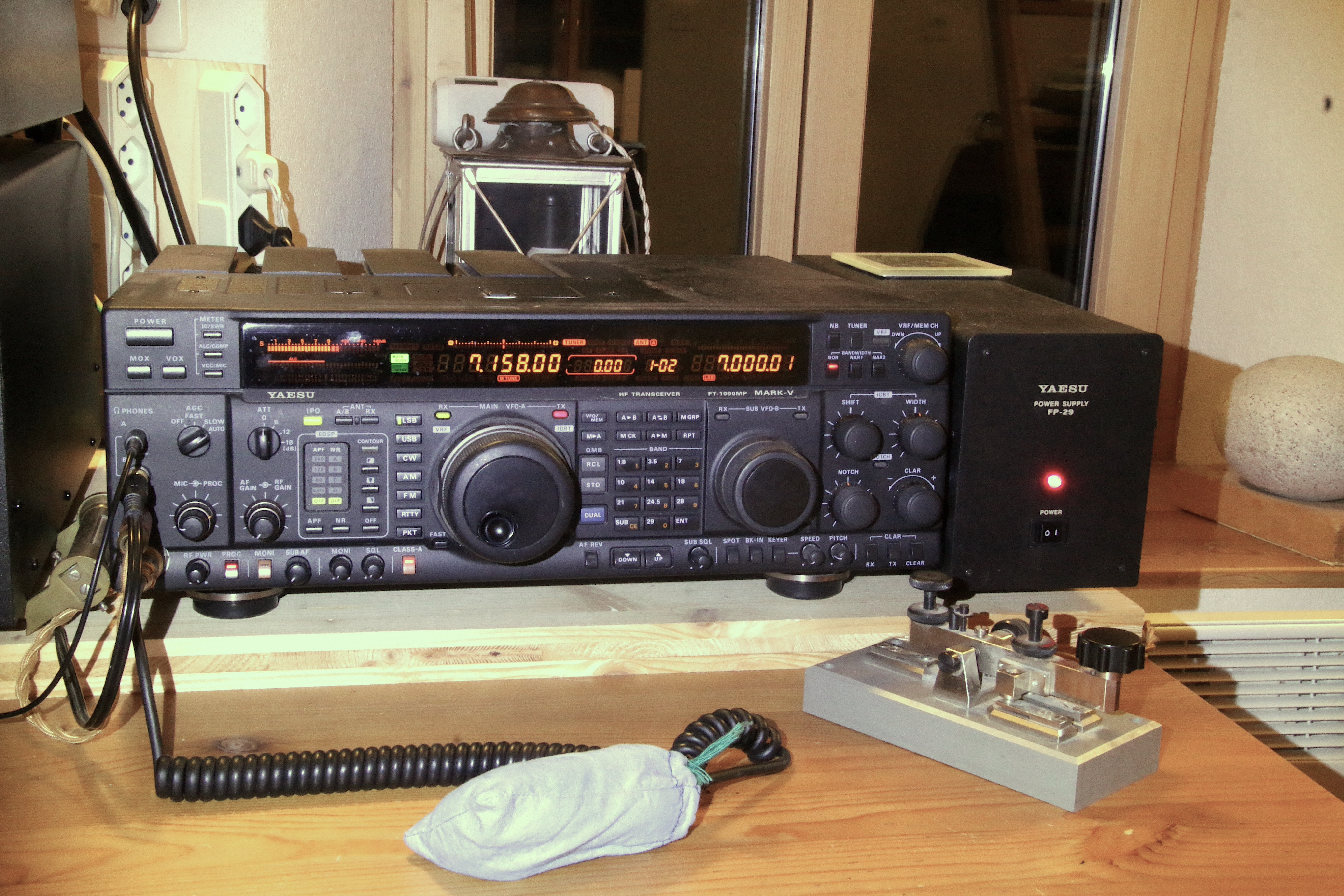
Weak Signal Propagation Reporter (WSPR) transmits a standardised beacon-style message every two minutes. WSPR is used for propagation research rather than communication; stations monitoring WSPR frequencies upload reports to a central database (wsprnet.org), creating a continuously updated map of active propagation paths. Running WSPR intermittently on an HF transceiver provides immediate feedback on which bands are open and to which regions.
Contesting as a Learning Tool
Amateur radio contests concentrate hundreds or thousands of stations onto the HF bands simultaneously, creating an environment where propagation conditions become immediately apparent. Major contests like the ARRL DX Contest (February, CW; March, SSB) and the CQ World Wide DX Contest (October, SSB; November, CW) see heavy participation from Canadian operators and provide contact opportunities with stations in most countries.
For operators developing long-range operating skills, contesting accelerates learning of band conditions, efficient contact procedures, and pile-up management in a structured context with clear logging objectives.
Auroral Effects on Canadian HF Operation
Canada's northern latitude means that geomagnetic disturbances affect HF propagation more frequently than at lower latitudes. During elevated K-index events (K ≥ 4–5 for southern Canada, lower thresholds farther north), F2 layer propagation on the higher HF bands degrades significantly. Signals on 20m and above may disappear entirely during major geomagnetic storms.
Conversely, intense aurora occasionally supports E-layer propagation at VHF frequencies (the 6m and 2m bands), a phenomenon known as auroral E-skip. This produces distinctive distorted signal characteristics on voice, but supports CW and digital mode contacts on VHF at distances not normally reachable on those bands.
External References
- NOAA Space Weather Prediction Center — Solar flux, K-index, aurora forecasts
- PSK Reporter — Real-time FT8/digital mode propagation map
- DX Maps — Amateur propagation reports by band
- WSPRnet — WSPR beacon propagation database
- ARRL Propagation Resources — Educational material on HF propagation